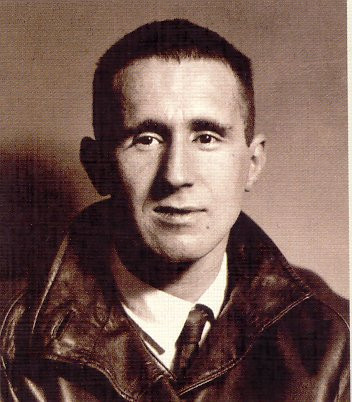
What is crucial is that actions are not developed from characters, but that characters are developed from actions. Brecht
In order to liquidate this theater, i.e., dismantle it, get rid of it, sell it off at a loss, we must call on science, just as we have called on science to liquidate a whole lot of other superstitions. Brecht
I came to read the work of Brecht purposefully to vividly visualize one of the characters I am developing for a novella. I mean purposefully because I have read him sporadically before; in relation to this character what interested me was Brecht’s take on the crime novel, even his general take on art and the literary. Which seems to be symptomatic of his approach to the theater, as he is a playwright first and foremost. First, I will try to outline his point in relation to the crime novel stipulated in the short essay On the Popularity of the Crime Novel, and then critically write on what I would like to call the literary mathematics. But I would argue, it can’t be divorced from affect of the form; which is part of the notion of poetics operative here, it puts under question mark if there is such a thing as ‘outside of Poetics.’
Right in the first paragraph Brecht contrast the crime novel to what he calls psychological literature, whose popularity among the mass surmount the former. This attributed to the mathematical precision of the crime novel, which makes it “only championed by community of connoisseurs.” And this ‘nature’ of the novel calls for an intellectual decipherment; this is what makes it different from ‘literature’, for they correspond to what one might call‘the expressionist subject.’ By this token the crime novel is not literary qua the psychologism of the latter, the crime novel is a ‘crossword puzzle.’
The signifiers like logical thought, pattern, the intellect populate the crime novel. The pattern is seen in the character and motivation for the murder rarely changing. The novelist follows this formulaic appearance; this appearance is maintained for the work to be showed in its multiplicity. Thus, originality for Brecht is not to be found in tweaking this appearance, for its necessary rendition, to quote Brecht “anyone exclaiming it is always the same, on ascertaining a tenth of all murders take place in the vicarage has not understood the crime novel…they might as well exclaim it’s always the same in the theater as soon as the curtains raises.” This for Brecht as much as the rise of the curtain is built into the theater, so is the necessary appearance is built into the crime novel. Thus, originality lays “in the variation of on more or less fixed elements, and this is that which confers the entire genre its aesthetic cachet.”
Another thing that makes the crime novel different from literary works is that it appears to the intellect, it contains element that provokes it “the reader is put in a position to set about finding a solution himself.” It is up to the reader to assume the role of the detective in the novel and piece together what he or she observed. Brecht assert that this equals the physicist method where hypothesis is developed, which is tested after the process of eliminating or elucidating new facts in relation to the incident. Thus, the murder is an effect if the hypothesis is right which appears in space and time.
Brecht assert that characters are developed from action because people’s actions are over determined and obscured by the same token so are their motivations, this is almost the reversal of the romantic edict. Thus, for Brecht, one constructs a character by stitching together elements.
The crime novelist is a physicist turn a novelist infusing texts with the scientist passion for causation. On the contrary to popular opinion of Dada or surrealism fitting the age, the crime novel perfectly suits the need of scientific age. Thus, the popularity of the crime novel is not only attributed to some suspension produced by reading a man in action on ordered sets of action, but also, Brecht postulates, “people in real life find that they have never left their clues behind, at least as long as they don’t become criminals and the police hunt down their traces. The life of the atomized mass of the people and collectivized individual of our age takes their course without trace. This is where the crime novel will provide certain substitutes; this means that in the crime novel we are served up with individually marketed segment of life, isolated small scale complex, in which causality functions in satisfactory way.” This sort of pleasure come to be when the novelist leads us to rational calculation, he/she achieves this by “mastering the art of seduction through characterization.”
In this what matter is motivation and opportunity count and to judge the murderer one must paint down on him a murder through mechanism involved in the crime novel akin to the scientific method. Thus, Brecht puts it “the crime novel does not indicate a more direct way to discover it is moral.” the normative is the effects of the mathematical maneuvering within the crime novel.
Let’s conclude this relative review by quoting one of Brecht’s important statements for this essay “…a few tricks remove the source of disruption. The range of vision is skillfully narrowed down, and the conclusions are drawn retrospectively from the standpoint of the catastrophe. Because of that we arrive at the position which is of course very favorable for speculation.”
The Affect of the Form (aof)
From the standpoint of the catastrophe we speculate as follows; the movement from the brute to the ecological capture what I would like to call realism without realism. The brute embodying the crime novel described above, the form of the formalist, epitomized by mathematical precision; it invokes a sense of a machine that denies its maker. While the latter is ecology without ecology, lacking its academic mapping, which speaks to the romantic ethic of suspension, where the esoteric torment every object perceived or imagined; a sensibility of surrealism without the communist party, the surrealism of Artaud. Thus, to see realism without realism one must go through this zero-level of surrealism; this infuses the thrust for the form.
Zizek in raging against a form of theater that relies on psychological realism, that cuddle us via projecting personalities, calls for a minimalism where people are “…reduced to their ideologico-political stance, no depth of the real person behind.” This stance in the context of ‘the literary’ calls for the third term. For example, in the binary, of the brute and the ecology, it would be the ecological, realism and surrealism, it would be surrealism, and the crime novel and literature, it would be literature. Those third terms are irreducible, they are that impossible gaze (the name of literature par excellence) that gives vitality to what is supposedly the outside of poetics.
It is neither this nor that, this vitality constructs the romantic of urban concrete; a vitality that calls upon the gaze of the child (which is a sovereign gaze), for they debilitate the distinction between the brute and ecology, and for they see a thriving ecology between concrete walls; because of this the child is raison d’tere of poetics.
The third term echoes Bataille’s reading of Sartre’s take on Charles Baudelaire;
For the rest of us, it is enough to see the tree or the house. Absorbed as we are in contemplating them, we forget ourselves. Baudelaire was the man who never forgot himself. He watched himself seeing, he watched in order to see himself watching. It was his awareness of the tree or the house which he watched…They did not point to each other like a signpost or a book marker … Their immediate mission was to bring the individual back to self-awareness. There was an original distance between Baudelaire and the world, which is not ours. Between the objects and himself there was always a somewhat cloying lucidity, like a breath of warm summer air.
A statement that lucidly distinguishes between poetic vision and everyday life, for Bataille; the two examples of the future determining the present, a vision that are not sovereign for Bataille. It is subordinate to our search for the road or for the page (which we are about to read). In other words, the present (the signpost or the book marker) is here determined by the future (the road or the page). The ‘paler, smaller, less touching’ things, on the other hand, to which Baudelaire opened his eyes sovereignly, did not suppress him for they served ‘no other purpose than to give him the opportunity of observing himself as he saw them.
This third term makes any attempt to be governed by an objective constellation without this primordial vision of poetics problematic, whether it is Brecht’s description of the crime novel or Mute, a character that absolutely assumes his ideologico-political position, whose function is a function of objects and the built, the ultimate truth of architecture.
Thus, the seeming contradiction in posting an affect and a form can’t be operative when one start from that primordial position; form might echo a certain degree of dehumanization, where the human become a margin subordinated to object. And affect in opposition to this is seen as in intersubjective terms; one of human quality that condemns any formalist reading of the world into nothing.
Let’s conclude by reciting part of my prose to Guillaume Apollinaire and a quot from Antonin Artaud’s the Theater and its Double , which might explain form (the analytical, the understanding and the scientific) is not the enemy of romanticism;
Apollinaire, forgive my rumbling, in meeting you I have become drunk; drunk in cement, and with it I swallowed its purpose. Its owner was shouting at me, cursing me as a thief and sick, he said, “your stomach shall betray you, jump out of you to be saved when they see a living being.” He didn’t know his cement was the way, the truth to see from the eye of the built environment. Tell me, Apollinaire, what kind of meaning you would have invested to this vision of the world, our world, let me be humble and say my world? Is it that which you would have recognized, if you had rewritten Zone?
The point, at the end of every road, at the corner, the material one; I was blind to this, till I wake up one day and saw clearly the stocked stones shining brightly in the name of words, that denied the mystical status of the bleating bridge. If happiness meant anything, it is when everyday objects lay on your hand. A site, Alcools couldn’t have imagined, but made possible to ask, Guillaume, ‘do I need your blessing to baptize this bridge?’
Where is the space of literature? It can be only be perceived in an encounter you had, when you see children’s, carrying there bag back, weaving through the library of the white giant eggs of P.H.Q.S, and recuperate there mapping of the building, its component, the high ceiling, the wide windows, the curve of the steps, the white columns, as white as Breton’s description of towers of needles standing in the valley; they induce a communication, the blind spot of the engineer, between corners formed by the walls and the windows; a thriving ecology where the pineal eye of the adult is the normal eye of the child.
Artaud write;
Practically speaking, we want to bring back the idea of total theater, where theater will recapture from cinema, music hall, the circus and life itself those things that always belonged to it. This division between analytical theater and a world of movement seems stupid to us. One cannot separate body and mind, nor the senses from the intellect, particularly in a field where the unendingly repeated jading of our organs calls for sudden shocks to revive our understanding.